
A common narrative in the tech world suggests:
".NET and C# fell behind Python in the AI revolution."
From a surface-level perspective community size, library ecosystem, and educational adoption Python clearly dominates artificial intelligence development. However, framing this as a simple "loss" oversimplifies a far more nuanced reality.
What we are witnessing is not technological failure, but the natural outcome of two ecosystems evolving with different priorities.
This article examines why C# occupies a more limited space in AI today through historical, strategic, and ecosystem-driven lenses.
1. The Nature of the AI Race
Programming languages tend to specialize over time:
- JavaScript → Web interfaces and interactive applications
- C/C++ → System-level and performance critical software
- C# → Enterprise applications, Windows ecosystem, and game development
- Python → Academic research, data science, and rapid prototyping
C#, guided largely by Microsoft's strategy, became deeply embedded in enterprise software development. The .NET ecosystem prioritized reliability, type safety, scalability, and production-grade architecture.
Python, by contrast, emphasized readability, accessibility, and development speed. This made it particularly attractive in academic environments.
The AI inflection point emerged precisely at this intersection.
2. Academia and the Open-Source Multiplier Effect
The AI revolution did not originate in corporate IT departments. It began in research labs.
Key foundational libraries were Python-first:
- NumPy
- pandas
- TensorFlow
- PyTorch
Between 2008 and 2016 — the critical deep learning expansion phase:
- Research papers published Python code examples
- Open-source AI projects were predominantly Python-based
- Online learning platforms standardized around Python
This created a powerful network effect. Python became not just a language choice, but the de facto standard for AI experimentation and research.
Network Effect
Once a research ecosystem consolidates around a tool, inertia becomes a competitive advantage.
3. The "Glue Language" Strategy
Python's success in AI is not primarily about raw performance. It is about architectural positioning.
Heavy computation in AI workloads typically runs in:
- C/C++
- CUDA
- Highly optimized numerical backends
Python acts as an orchestration layer a so-called "glue language." It:
- Defines models
- Manages training processes
- Coordinates data pipelines
- Interfaces with optimized native libraries
Technically, C# could have fulfilled a similar orchestration role. However, during the formative years of modern AI, Python had already consolidated this position. Timing matters in ecosystem dominance.
4. Data Science Culture and Tooling
Data science evolved not only as a technical discipline but as a workflow culture.
Tools like Jupyter Notebook and Matplotlib enabled interactive experimentation rapid iteration, visualization, and immediate feedback. This aligned perfectly with research and exploratory development.
Meanwhile, the .NET ecosystem focused heavily on production grade systems, long-term maintainability, and enterprise reliability. It did not initially prioritize experimental, notebook-driven workflows.
This cultural divergence significantly influenced AI adoption patterns.
5. ML.NET and the Timing Factor
With ML.NET, the .NET ecosystem made a formal move into machine learning.
However, by this stage:
- Python's ecosystem was mature
- Community support was extensive
- Educational pipelines were firmly established
Microsoft's historically enterprise-focused strategy favored stability and controlled evolution. While sustainable, this approach limited early dominance in the fast moving, open-source driven AI surge.
This was not a capability gap it was a timing and positioning difference.
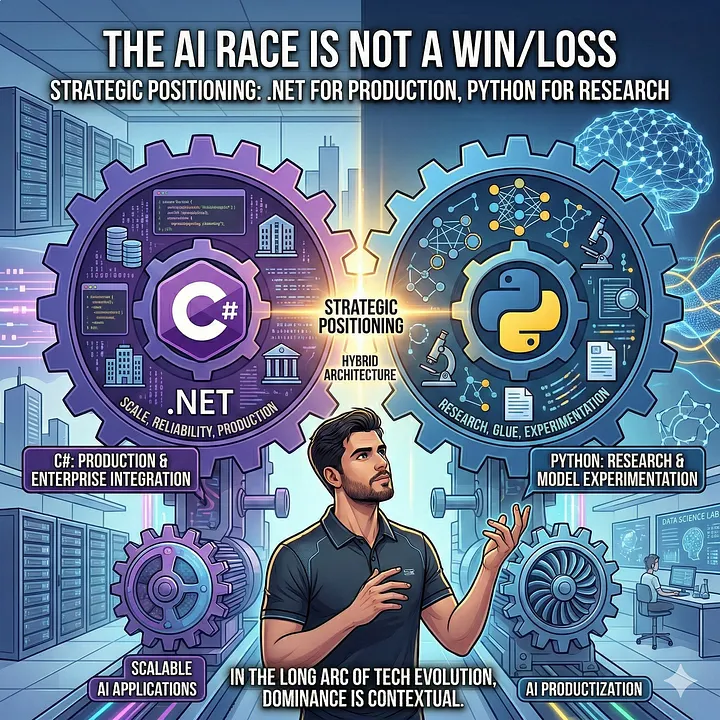
6. The Current Reality: Hybrid Architectures
In modern production environments, a common pattern has emerged:
- Model development → Python
- API and service layer → .NET
- Enterprise integration and scaling → Cloud platforms
This hybrid distribution is technically rational.
Python remains dominant in research and model iteration. .NET remains strong in structured backend services, enterprise integration, and scalable system design.
Rather than competing head-to-head, the ecosystems frequently complement each other.
7. Perception and Brand Positioning
Technology adoption is not purely technical it is also psychological.
For years, C# was perceived as: "The enterprise/Windows language."
Python, meanwhile, became: "The accessible language for everyone."
In experimental and innovation-driven domains like AI, perceived openness and flexibility can influence adoption just as much as technical capability. Community psychology shapes ecosystems.
Conclusion
.NET and C# are not technically inadequate for AI. They evolved with different priorities.
Python leveraged academia, open-source momentum, and data science culture to dominate AI research and experimentation. C#, on the other hand, strengthened its position in production systems, enterprise architectures, and scalable backend services.
This is not a narrative of defeat. It is a case study in strategic positioning.
Python dominates AI research. AI productization, however, continues to require multidisciplinary engineering, where ecosystems like .NET remain deeply relevant.
In the long arc of technological evolution, dominance is often contextual not absolute.